Afghan crochet, also called Tunisian crochet, looks like a cross between knitting and crochet. You keep a whole row of loops on a long hook, then work them off again, and the result is a firm, square grid that is perfect for blankets and dishcloths.
This guide teaches the basic stitch, the Tunisian simple stitch, in two passes per row. When the rhythm clicks, make the little practice dishcloth at the end.
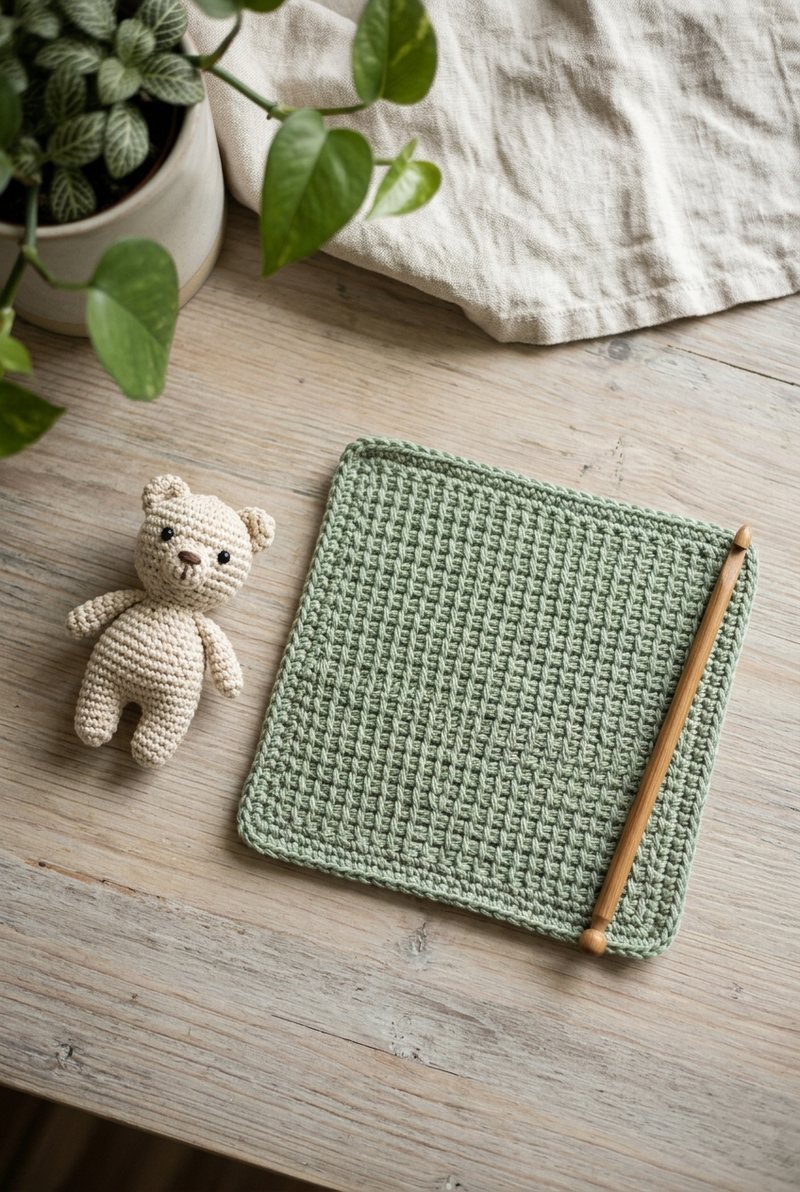
Learning Afghan Crochet Step by Step
What You’ll Need
- Sport / fine (size 2) cotton yarn: worsted (size 4) cotton in one colour, about 50 g for the dishcloth
- 6 mm afghan (Tunisian) hook: a long hook with a stopper at the end, so it can hold a whole row of loops
- Tapestry needle and scissors
- Tapestry needle, sewing pins and a stitch marker
The finished size depends on your yarn and hook: thicker yarn and a bigger hook make a bigger piece.
Abbreviations (US terms)
- MR magic ring
- sc single crochet
- inc increase: 2 sc in the same stitch
- dec decrease (an invisible decrease gives the smoothest finish)
- ch chain
- sl st slip stitch
- TSS Tunisian simple stitch: insert the hook under the front vertical bar and pull up a loop
- FwP forward pass: picking up loops from right to left
- RetP return pass: working the loops off from left to right
- R round; Row row worked flat; the number in brackets is the stitch count at the end
The First Row: Forward and Return Pass
Every row has two passes. Do not turn the work: the right side always faces you.
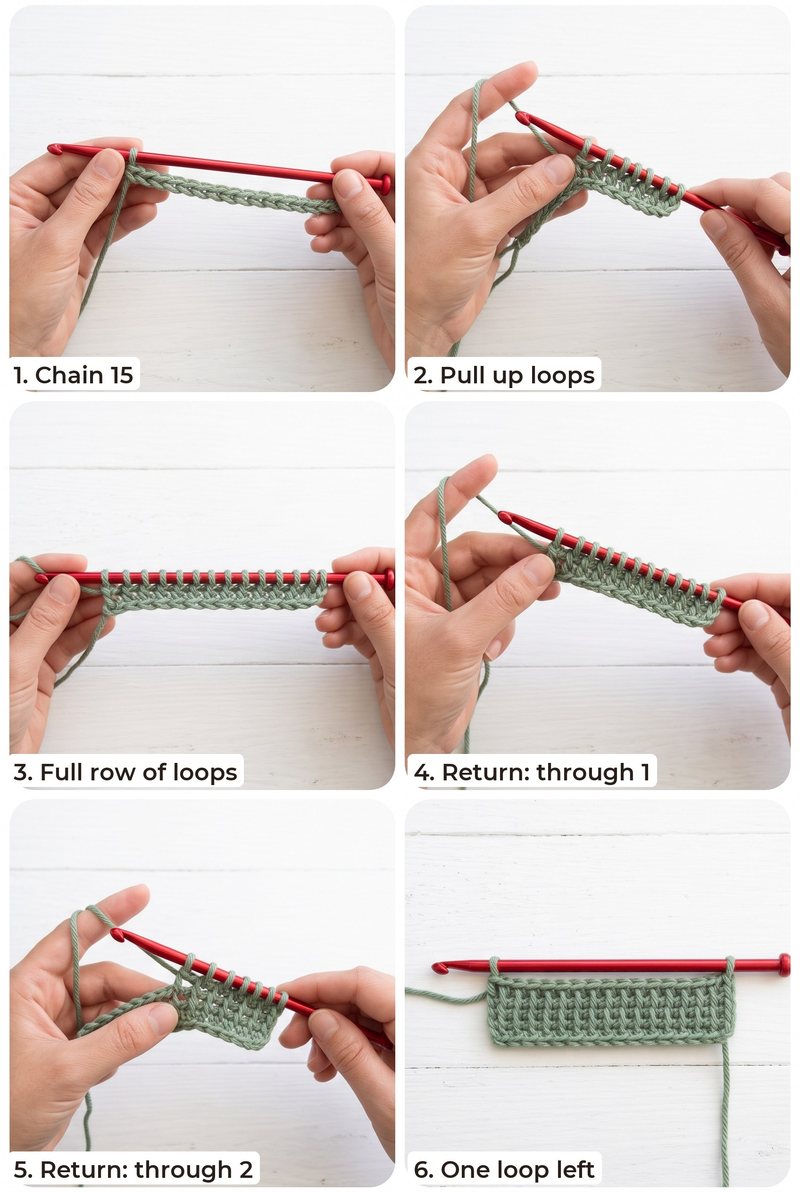
Practice swatch (one colour, make 1)
- Ch 15. Forward pass: skip the first ch, insert the hook in the next ch and pull up a loop; repeat in each ch across (15 loops on the hook).
- Return pass: yarn over and pull through 1 loop, then *yarn over and pull through 2 loops* until 1 loop is left. That loop is the first stitch of the next row.
- Row 2 forward pass: skip the first vertical bar, insert the hook under the next front vertical bar and pull up a loop; repeat across (15 loops). Work the return pass as before.
- Repeat Row 2 for 10 rows. Finish with a row of slip stitches under each vertical bar so the top edge is flat.
Next Rows and a First Dishcloth
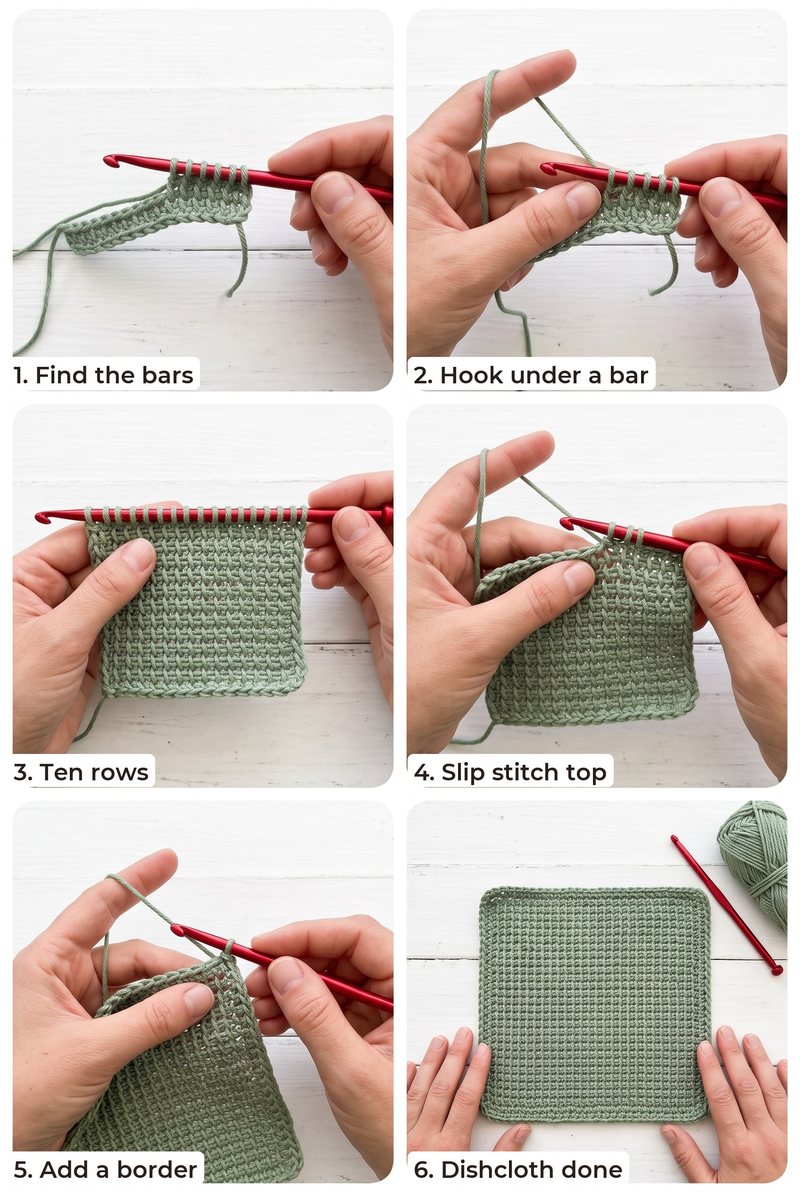
Dishcloth (one colour, make 1)
- Ch 30. Work the forward and return pass as for the swatch (30 loops on the hook).
- Rows 2-26: Tunisian simple stitch, forward and return pass (30 loops each row).
- Last row: slip stitch under each vertical bar. Do not fasten off.
- Border: ch 1 and work sc evenly around all four sides, 3 sc in each corner. Slip stitch to the first sc and fasten off.
- Weave in both ends on the back.
- Steam the dishcloth lightly and pin it square while it dries, because Tunisian crochet tends to curl.
FAQ
Is afghan crochet the same as Tunisian crochet?
Yes. Both names mean the same technique: loops are picked up on a long hook and worked off again in each row.
Why does my piece curl?
Tunisian simple stitch naturally curls. Use a hook one or two sizes bigger than the yarn label says, add a border and steam it flat.
Can I use a normal crochet hook?
For a narrow swatch, yes. For anything wider you need a long afghan hook or a cable hook to hold all the loops.
More Free Patterns You Will Love
Love these patterns? Get new ones in your Pinterest feed.
Follow us on Pinterest